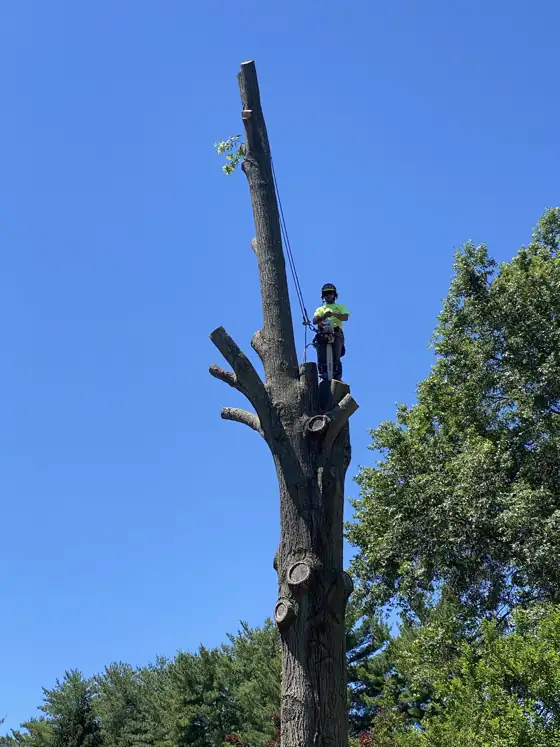
Removal that protects everything around the tree
Most trees that need to come down are not standing in an open field. They lean over roofs, hang above driveways and sit a few feet from a fence or a neighbor's garage. That is the work we are built for. When there is no room to drop a tree whole, we climb it, remove the limbs, and take the trunk down in sections, lowering heavy pieces on ropes instead of letting them free-fall.
When there is room, we fell the tree in one piece using a directional notch and a planned landing zone, so the log ends up exactly where we said it would.
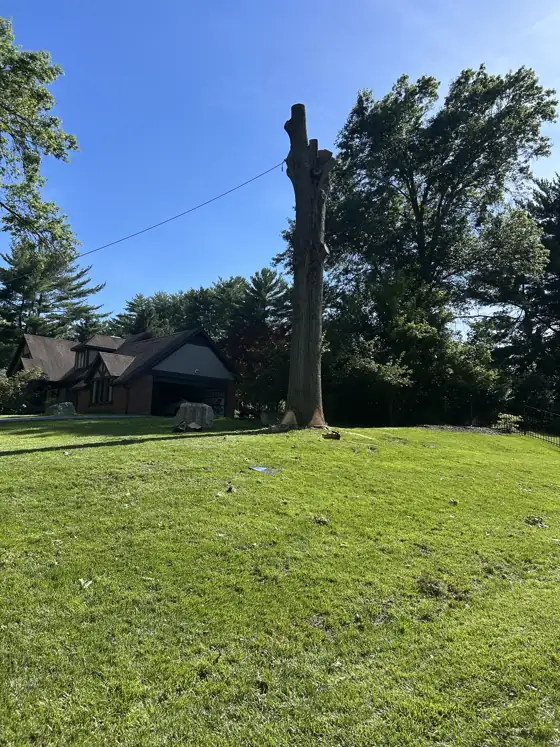
Signs a tree should come down
- Dead or mostly dead canopy. Dead wood turns brittle and becomes harder and riskier to remove the longer it stands.
- Trunk decay. Cavities, soft wood, or mushrooms growing at the base or on the trunk.
- Cracks and split unions. A V-shaped fork with a crack running down it can fail without warning.
- A lean that has changed. Heaving soil or exposed roots on the opposite side of a lean is a red flag.
- Declining ash trees. Emerald ash borer is established in Missouri. Infested ash dries out quickly and becomes dangerous to climb, so earlier removal is usually safer and cheaper.
- Too close to the house. Trees rubbing the roof, crowding the foundation or overhanging bedrooms.
What's included
- A free, written estimate after we see the tree in person
- Climbing, rigging or bucket work as the job requires
- Brush chipped and hauled away
- Logs hauled, or cut to firewood length and left for you on request
- Raking and blowing off the work area before we leave
- Optional stump grinding the same day or scheduled after
Tree touching a power line? Stay back and call your electric utility first. Lines that run to the house or along the street must be handled or de-energized by the utility before anyone works near them. We will coordinate the rest.
What affects the cost of tree removal
Every tree is priced on site, because two trees of the same height can be very different jobs. The biggest factors are:
- Size and trunk diameter. More wood means more cutting, lowering and hauling.
- Access. A front-yard tree we can reach with equipment is faster than a backyard tree behind a fence.
- What's underneath. Roofs, decks, fences and lines mean more rigging and smaller pieces.
- Condition. Dead or decayed trees need extra care to climb and dismantle safely.
- Cleanup choices. Full haul-away versus leaving firewood, and whether the stump gets ground.
Tree Removal FAQ
Do I need a permit to remove a tree?
Trees on private property in most of the area can be removed without a permit, but some municipalities and many HOAs have their own rules, and trees in the strip between the sidewalk and street often belong to the city. Ask us during your estimate and check with your city or HOA if you are unsure.
Will you damage my lawn or driveway?
We plan the work to protect them. Heavy pieces are lowered on ropes, and we use mats or plywood under equipment where turf or pavement needs protection. Any concerns get talked through at the estimate.
Can I keep the wood?
Yes. Tell us and we will cut the trunk to firewood length and stack it where you want it. Leaving the wood can also lower the price.
How long does a removal take?
Most residential removals are finished in a single day, including cleanup. Very large or complex trees can take longer, and we will tell you up front.